
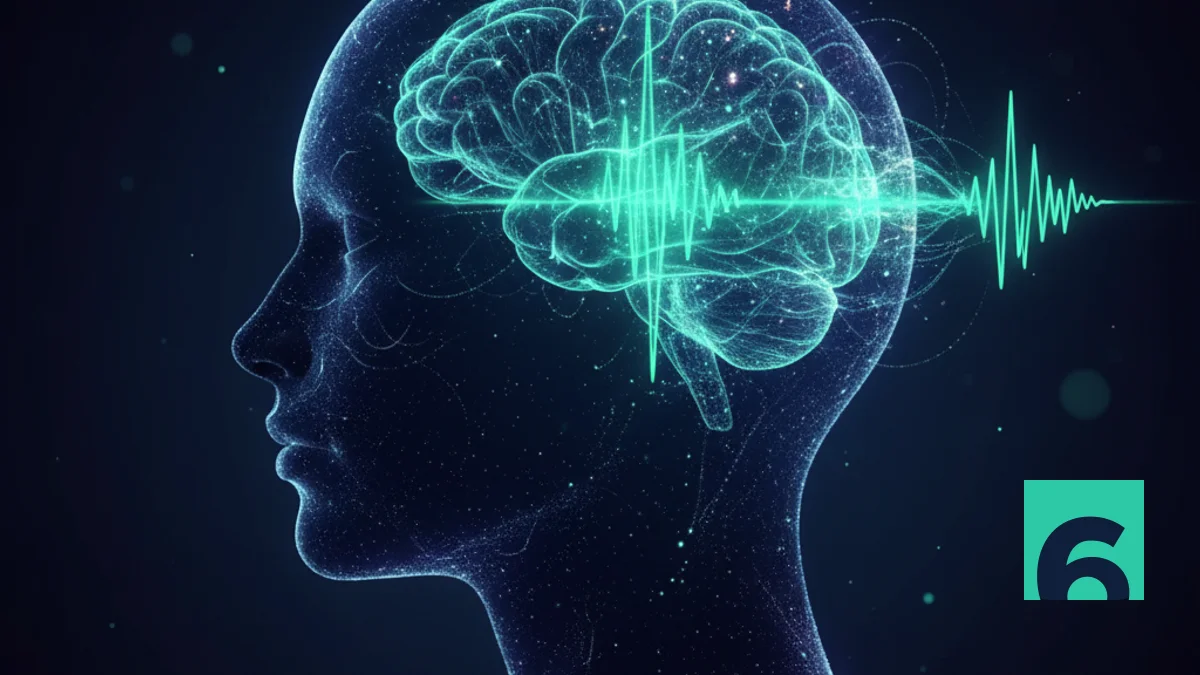
The world is sitting inside a slow, grinding mental health crisis. Gallup says 19.1% of US adults, about 51 million people, are being treated for depression as of 2026, and 28.5% report having been diagnosed at some point in their lives. The WHO puts the global number of people living with a mental health condition at more than one billion. Anxiety and depression shot up during the pandemic, and they still haven’t really settled back down.
When people run into these problems, they usually end up cycling through the same five kinds of responses: getting more physically active, chasing positive feelings, trying to think or meditate their way out of it, working through structured systems like CBT, or taking drugs. Those help plenty of people. They also leave plenty of people behind.
That gap is why we started Sixth Technology. A sixth response has finally matured into something real, and the evidence is now good enough that it deserves to be treated as a clinical discipline, not a niche curiosity.
Why “Sixth”
Most mental health care options fall into five buckets.
First comes the body. Exercise changes the brain’s chemistry, dopamine, serotonin, BDNF, the stuff your brain needs to work well and keep mood steadier.
Second is emotion. When you do things that feel good, time with people, travel, anything that brings pleasure, your attention isn’t locked as tightly onto the negative thought loops that show up in anxiety and depression.
Third is the mind. Logic can push back against painful thoughts. Meditation can quiet the whole stream.
Fourth is method. CBT, ACT, mindfulness programs, these are structured approaches, usually with a teacher or guide, and they mix physical, emotional, and cognitive techniques into a plan.
Fifth is biochemistry. Medication can shift brain chemistry fast. It’s also where you have to be the most careful, because every drug comes with unintended effects, and some people can’t take the best-fitting options due to pregnancy, breastfeeding, other conditions, or medication interactions.
And then there are cases where none of these five really fit. That’s where we work.
The sixth response is non-invasive technology that influences the brain directly, using light, sound, electrical current, or magnetic fields, without breaking the skin and without changing biochemistry through drugs. That’s the “Sixth” in the company name.
A wider family of non-invasive brain stimulation
Once you look across the category, you start to see the range.
tDCS sends a low electrical current through electrodes placed on the head. For at-home use, it has some of the strongest evidence for depression.
tACS is similar, but uses alternating current at a chosen frequency, tuned to match particular brain rhythms.
tPBM uses near-infrared light to affect how cells produce energy and how blood flows in the brain.
tVNS targets the vagus nerve through the ear or neck to shift the nervous system.
All of these methods, tDCS, tACS, tPBM, tVNS, and AVE, are non-invasive. No surgery. And for home versions, no prescription and no drugs. There’s published research behind all of them, and the tools are getting better.
We chose AVE as our focus, on purpose.
tDCS and tACS can carry seizure risk and other complications if someone pushes doses too high without supervision. tVNS brings risks for the heart, and for people with implanted medical devices. tPBM is usually safe, but researchers are still working out which wavelengths and schedules are best.
AVE, in contrast, has very few downsides. It uses pulsed light through closed eyes and sound through headphones or speakers. The major contraindication is light-triggered seizures, which means screening matters. Beyond that, no electrodes, no implanted devices, no current, and nothing touches the skin except headphones.
Because the safety profile is so broad, AVE is one of the most widely usable options. People can do it safely at home, without medical supervision. The mechanism isn’t speculative either, the frequency-following response has been measured with EEG since 1965. We still keep an eye on the other approaches and learn from them, but AVE sits at the center of what we do.
What 50+ years of AVE research actually shows
In September 2025, a University of Milan team published a paper in Brain Sciences. It’s the first peer-reviewed review focused only on audio-visual entrainment, covering fifty years of studies. Three takeaways line up with what we see in our own work.
For depression, repeated experiments suggest stimulation at 14 Hz, right at the lower edge of the beta range, can lift mood. One possible reason is that it corrects frontal alpha asymmetry, a known electrical marker in depression where the left frontal cortex shows less alpha activity than the right.
For anxiety, stimulation around 10 Hz in the alpha range appears to teach the brain to move from high-beta vigilance into a calmer state. In studies, multi-session protocols bring down scores on standard anxiety scales.
For insomnia, protocols often transition from alpha down to delta. A session starts in relaxed alpha, moves through theta, and ends in delta, following the brain’s natural path into sleep. Trials report shorter time to fall asleep and better sleep quality, and unlike sleep medication, this doesn’t build the same physical or psychological reliance.
The review also doesn’t pretend the field is finished. Many studies have small samples, methods vary widely, and there aren’t enough large, blinded trials. We agree. Our view is that the right move is to do the work that gets the field past that stage.
The process in Sofia
Our Sofia office is where the research meets the person in the chair. Sessions follow a consistent arc.
A patient sits in a quiet room. Before AVE starts, we record two minutes of brain electrical activity using a Muse band with four sensors at AF7, AF8, TP9, and TP10. At baseline we measure alpha peak frequency, alpha and beta power, permutation entropy in both bands, and asymmetry in the front and back of the brain (Frontal Alpha Asymmetry and Posterior Alpha Asymmetry).
Then the patient keeps their eyes closed and relaxes in front of a Roxiva lamp while wearing headphones. Roxiva is a professional AVE device, it delivers pulsing light and isochronic tones with millisecond-level timing precision. The program isn’t chosen at random, we pick from a catalog of protocols designed for different conditions, using the patient’s intake questionnaires, their current presentation, and how they responded to earlier sessions.
Afterward, we record EEG again, compute the change, and store the data. Over a protocol of 10 to 15 sessions across three weeks, patients also fill out standard scales at intervals, like HAM-A and HAM-D.
Two proprietary measurements come out of this.
The Session Improvement Index captures the immediate, visit-by-visit change. It tells us whether that day’s program produced a measurable shift.
The Baseline Index tracks resting brain activity across the whole protocol. It shows whether there’s a cumulative trend over weeks, the kind of change that suggests something lasting.
We track both because they answer different questions.
This two-layer tracking is the methodological core of our work. It’s also the most defensible part of our competitive advantage: most consumer AVE products collect no objective data at all, and most clinical AVE studies lean heavily on questionnaires without doing EEG before and after every session.
The same data feeds our AI-assisted session selection. A machine-learning model trained on hundreds of prior sessions matches patients with the programs that produced the best EEG and questionnaire outcomes for similar profiles. It uses the pre-session EEG, the patient’s condition, intake forms, and treatment history. The model gives a primary suggestion and a few alternatives, but the clinician makes the final decision and can ignore the model. When that happens, we record the disagreement. That disagreement is valuable feedback, and it’s one of the ways the model gets sharper over time.
What our own data shows
We’ve studied our dataset closely, and we try to be disciplined about what we claim.
Across 800+ sessions with 80 patients in Sofia, we see measurable improvement on our EEG Baseline Index in 82% of patient programs that include 10 or more sessions (n=39). Looking at the immediate response, 70% of measured sessions show a positive change on the Session Improvement Index.
Those figures are tied to the cohort that produced them. About half of patient programs don’t continue past 10 sessions, so the 82% reflects completers, not everyone who walks in the door. We also do not describe these results as a “cure,” as “proven optimal,” or as equivalent to medication. The signal is promising, and we’re direct about what we don’t yet know.
We see effects across the four conditions we target, anxiety, anxiety-depressive presentations, depression, and insomnia, but the size of the effect varies. Insomnia and anxiety-depressive presentations tend to show the biggest shifts. Pure anxiety often responds more modestly. That gradient matters to us, because it’s information we can work with.
People also ask why we haven’t completed a formal randomized controlled trial yet. The honest answer is that sham controls in AVE are hard. There isn’t an obvious inert placebo. If you remove the light or sound, you ruin the intervention experience. Random flashes and audio still change arousal. Even “wrong” frequencies can entrain brain activity to some degree. The wider field still doesn’t have a clean answer for a sham condition that feels real but has no therapeutic effect.
What we do instead is collect objective EEG before and after every single session, for every patient. That gives a within-subject signal that doesn’t depend on a sham comparator. It’s not a replacement for a properly blinded RCT, and we don’t treat it as one. It is, though, more rigorous than the questionnaire-only evidence that still dominates much of the field.
Two routes to the same science
One office in Sofia, no matter how carefully run, can only serve so many people. The gap we started with is measured in hundreds of millions. A global solution can’t live in a single room, so we built the app.
But the office doesn’t go away as the app grows. They solve different problems, and we expect them to run in parallel.
The office provides things an app can’t. The Roxiva lamp is engineered for AVE, with intensity and timing precision beyond what a phone flash can reproduce. Every visit includes Muse EEG before and after, so the next program is chosen based on your brain’s response, not an average profile. A psychotherapist is there with you, and a psychiatrist consults when the case needs it, so the work is interpreted by people treating you as a whole person, not a feature vector. And the 10-to-15-session arc compresses the deepest version of the protocol into three focused weeks. It’s the high-touch, high-personalization version.
The app gives a different set of benefits: accessibility, immediacy, daily cadence, and zero cost. It doesn’t have EEG instrumentation or a clinician in the room, but it carries the distilled protocols from the office into day-to-day life.
For us, the office is also what keeps the science honest. Every Muse recording, every Roxiva program choice, every questionnaire score, every dual-index calculation, and every time a clinician overrides the model feeds the dataset that both the clinical protocols and the app are built on. A consumer AVE app without that feedback loop is guessing. With it, it becomes something else.
6th Mind: the distilled know-how
6th Mind is the mobile app that carries the work outward. The technical idea is simple: modern smartphones have a high-intensity LED flash and stereo speakers. With the right software, that hardware can deliver three synchronized entrainment channels at once: photic stimulation through closed eyelids using the camera flash, isochronic tones through the speaker, and binaural beats layered in when the user connects headphones.
Because isochronic tones work through any speaker and don’t require stereo separation, sessions still work without headphones. When headphones are present, binaural beats add another layer and deepen the audio pathway. The result mirrors what we do in the office, delivered through a device you already own.
The app runs structured 11-minute sessions across a 15-day plan, with personalization driven by an intake questionnaire about emotional and cognitive state. Each session draws from the frequency profiles that performed best in the office for similar patient profiles. 6th Mind is free, no subscription, no ads, no extra hardware.
We don’t treat 6th Mind as a separate product line. It’s the practical output of the clinical work, the protocols, frequency choices, session structure, and duration tuning, packaged in a form that can scale. When we improve the office methodology, the updates roll into the app. When users send back completion rates, retention, and qualitative feedback, that information becomes hypotheses we can test in the office with full EEG.
Most AVE apps are built on someone’s intuition about brainwaves. 6th Mind is built on data from real sessions in a real office. You feel the difference quickly.
Have we reached the ceiling?
A lot of careful work went into 6th Mind. Frequency targets were selected condition by condition, based on the strongest signals we saw in the office. Inside each session, we shaped the progression so the brain is guided along a path that produces the cleanest EEG response. Carrier frequency shifts with the entrainment frequency instead of staying fixed. Light and sound are synchronized so they hit in lock-step rather than drifting.
All of that came from comparing before-and-after EEG across hundreds of sessions.
So the app is good, and we’re comfortable saying that. It’s the best AVE experience we know how to deliver on a phone right now.
The remaining question is whether it’s the best a phone can do. Are we already pushing the camera flash and speaker to the practical maximum, or is there still a meaningful gap, tighter synchrony, deeper immersion, a stronger photic dose, longer-lasting session effects? Over the next few months, you may see the answer. Watch this blog, and watch the updates.
Until then, if you want to feel what AVE is like today, the app is free. If you want to go deeper on the science, our explainer on audio-visual entrainment is a solid next step.
Sources
- “Audio-visual entrainment neuromodulation: a review of technical and functional aspects” - Brain Sciences, 2025
- “US depression rate remains elevated” - Gallup, 2026
- “US depression rate remains historically high” - Gallup, 2025
- “Depression prevalence in adolescents and adults (NHANES 2021–2023)” - CDC NCHS Data Brief No. 527
- “FDA grants Breakthrough Device designation for non-invasive brain stimulation device for MDD” - UNC Health, 2025
- “Audio Visual Entrainment (AVE): Mechanism of action and clinical applications” - Mind Alive