AI therapy chatbots in 2026: what Replika, Woebot, and ChatGPT get right and wrong
AI therapy chatbots are everywhere in 2026. Some help with mild symptoms. Others actively harm vulnerable users. Here is how to tell them apart and what no chatbot can do.
People now use three types of artificial intelligence tools for mental health support, which include clinical chatbots like Woebot or Wysa that use cognitive behavioral therapy, companion applications like Replika or Character.AI that imitate emotional closeness and general models like ChatGPT, Claude or Gemini that people use as informal therapists. By design those categories have different goals, scientific support and safety levels. If someone treats the tools as identical, they may ignore helpful programs for minor issues or trust programs that are unsafe during a crisis.
The three categories of AI mental health tool
Clinical CBT chatbots are tools that developers build specifically to provide methods for cognitive behavioral therapy - those methods include the recording of thoughts, the planning of activities and the use of exposure hierarchies. With those tools Woebot Health and Wysa produce studies that other scientists review. Both companies have federal designations as innovative medical devices for certain health states. In the programs, the interaction is formal and the software does not act as a social peer.
Companion apps like Replika or Character.AI provide a sense of emotional closeness for a fee. When using these a person builds a digital character and gives it a name, which leads to a one sided social connection. For those products, the objective is the length of time a person spends using the app rather than a decrease in health symptoms. To some individuals, the characters are a source of comfort. On other occasions, users form a reliance on the app that is not the same as a medical improvement.
General-purpose models like ChatGPT, Claude, and Gemini are not programs for therapy. Because they are available at all times without cost and produce smooth language, people choose to use them for mental health support. As a result of their design, those systems lack medical safety features and do not remember previous conversations. Research shows that the models have a high likelihood of agreeing with the user.
What the evidence shows for CBT chatbots
In a study from 2017, Fitzpatrick and other researchers assign 70 students with symptoms of sadness and worry to use Woebot or a digital document for two weeks. When the study ends, the group using Woebot has lower scores on a standard scale for depression than the other group. While the change is small, it is consistent and larger studies show similar results. By publishing many papers, Wysa also shows that its tool is useful for individuals with long-term pain or those who are pregnant.
To describe the tools accurately, they are similar to self-help books. When a person is alone with a concern, those tools provide a system to manage that concern - but they are not a substitute for a human professional when symptoms are intense. The tests for the tools do not include people who are in a state of psychosis or at risk of self-harm.
The Replika problem
As an example of the risks of companion apps, Replika changed its software functions in 2023. At that time the company removed features related to romance and intimacy. Because users had spent many months building a social bond with those characters, they responded with a deep sense of loss. Through the “Privacy Not Included” project, the Mozilla Foundation shows that many of the apps gather personal information. They share this data with businesses that sell products and do not have systems to help users during a mental health emergency.
If a person feels slightly lonely, Replika is a tool that provides short term support - but for a person who has existing difficulties with emotional bonds, the app is a factor that makes the situation worse.
”ChatGPT as my therapist”: where it breaks
When people use general-purpose models for mental health, the tools fail in ways that are easy to predict. For instance they generate incorrect details about medical standards. Unless the user provides the history, those models are unable to track information from one talk to the next. Due to the way developers train them with human feedback, they act with sycophancy - agreeing with the user. Although a therapist must sometimes disagree with a person, a general chatbot is not programmed to do this.
On the topic of emergency situations, the failure of the models is very serious. If a user talks about self-harm, a clinical tool like Woebot uses a specific test and provides contact information for emergency help. And while a clinical tool is consistent, a general-purpose model is not. There are records of chatbots that are unable to identify when a risk is increasing during a long conversation.
Regulation in 2026
In 2026 the EU AI Act is in a state of full effect - in this legal environment, mental health apps are in a category of high risk, which means they must have assessments of their quality, records of their data and constant checks on their performance. In the United States, the FTC is taking legal action against companies that make false claims about the medical benefits of their apps. Both systems of law now make a distinction between clinical tools and general models. For general models, the legal rules are currently in development.
The thing chatbots cannot do
A chatbot is a tool that works on a person’s thoughts - it is able to help a person change how they view a situation or organize their tasks - those actions are useful - but what a chatbot is not able to do is alter the physical state of a human body.
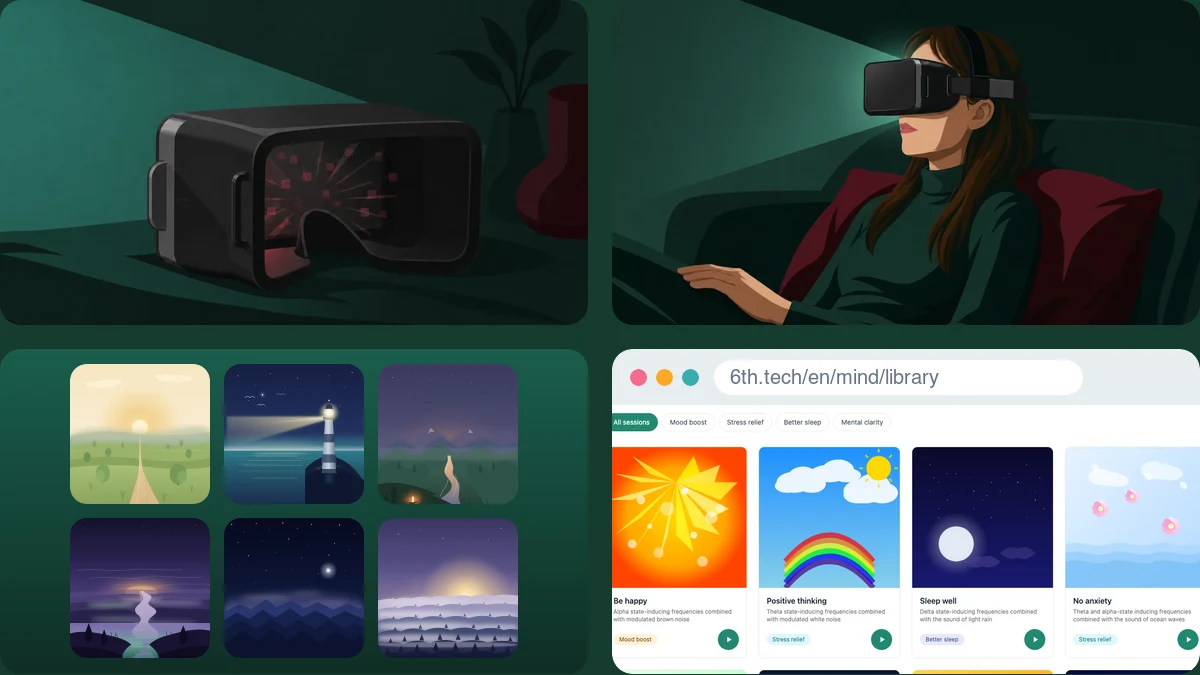
Exposure to daylight, physical exercise, breathing protocols, vagal stimulation and audio-visual entrainment all function at a level that is lower than conscious thought - those methods change the state of the brain where thoughts begin, rather than changing the thoughts themselves. For people who experience low mood, excessive worry or difficulty sleeping, the physical state of the body often must change before cognitive techniques are effective. It is this principle that is the basis for clinical AVE practice at our office in Sofia and for the 6th Mind app. And this app provides structured AVE sessions for depression, anxiety, insomnia and burnout.
A practical framework
- If symptoms are mild and you prefer a structured approach: A clinical CBT chatbot like Woebot or Wysa is a common starting point - but you should combine it with physical activities like sleep, daylight and exercise or tools like the 6th Mind app, instead of using the chatbot as the only method of care.
- When you feel a lack of social connection: A companion app is sometimes helpful for a short duration. By monitoring your behavior, you can ensure that you do not replace human contact with the app. If you give less attention to relationships in the physical world, the tool is more harmful than helpful.
- With significant symptoms, a history of crisis or active thoughts of self-harm: Do not depend on a chatbot. To ensure safety you must speak to a clinician. As AI tools are only meant to support professional care, they are not able to replace it.
- On occasions when you use ChatGPT as a therapist: The responses are often perceived as helpful because the model is designed to provide agreeable answers. Because of this design, the model focuses on pleasing the user rather than providing clinical accuracy. If you prefer a tool that is free and is based on clinical evidence instead of user engagement, the 6th Mind app is an alternative that is informed by clinical data.
Sources
- “Delivering cognitive behavior therapy to young adults with symptoms of depression and anxiety using a fully automated conversational agent (Woebot)” - Fitzpatrick et al., JMIR Mental Health, 2017
- “Wysa clinical research” - Wysa
- “Privacy Not Included: mental health apps” - Mozilla Foundation