What the first comprehensive review of AVE therapy reveals (and what remains unknown)
AVE therapy explained — what 50+ years of audio-visual entrainment research shows for depression, insomnia and anxiety, plus side effects and what's unknown.
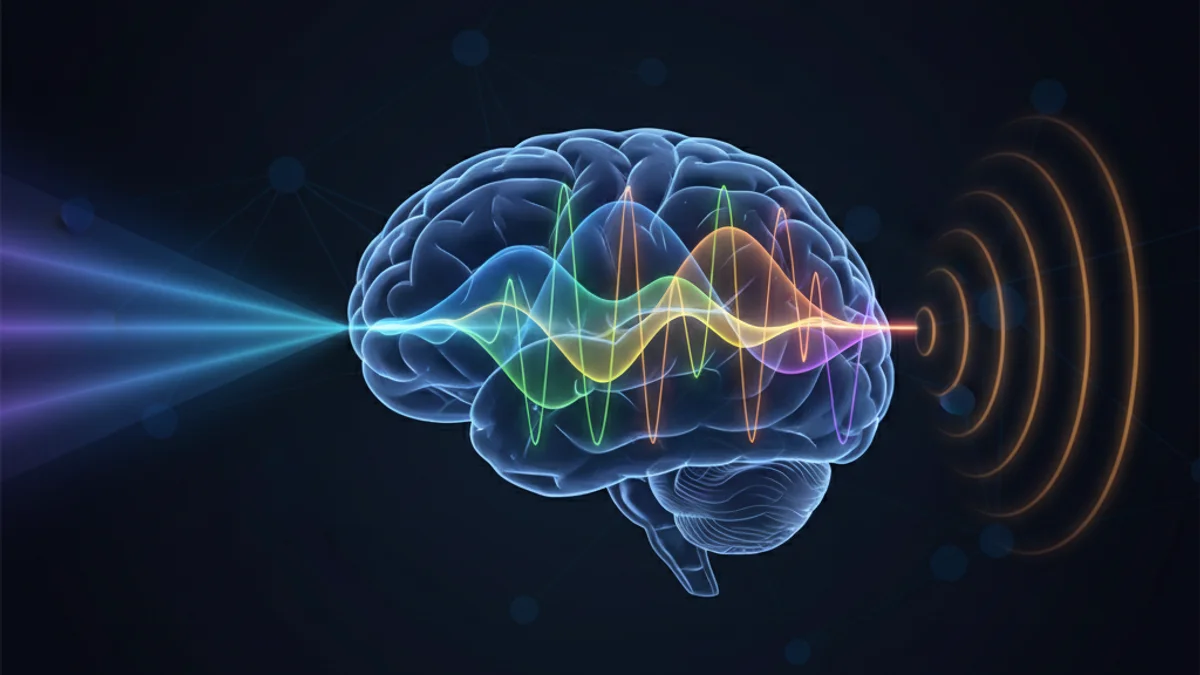
In September 2025, researchers at the University of Milan released the first peer-reviewed review that focuses only on audio-visual entrainment (AVE) therapy. The paper appears in Brain Sciences, covers more than 50 years of research and examines AVE applications for depression, insomnia, anxiety, ADHD, Alzheimer’s disease and chronic pain. The conclusion: results show promise across multiple conditions, but the field needs standardized protocols plus larger controlled trials before anyone can call the evidence definitive.
What AVE actually does to the brain
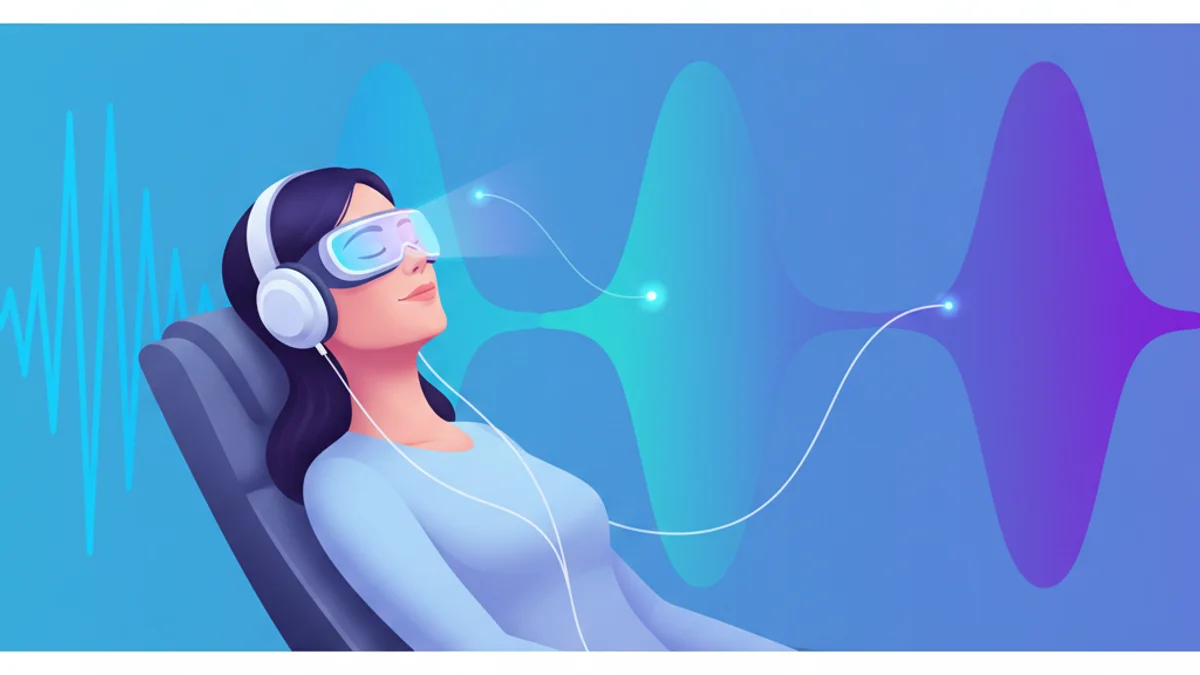
AVE therapy delivers rhythmic pulses of light through closed eyelids and sound through headphones at specific frequencies. The brain responds by synchronizing its electrical activity to the external rhythm, a process called entrainment. Different frequencies target different states: alpha waves (8–12 Hz) support relaxation, theta waves (4–8 Hz) appear during deep rest, and delta waves (0.5–4 Hz) mark deep sleep.
The key difference from binaural beats or audio-only approaches is the addition of photic (light) stimulation. The review notes that combining audio and visual channels produces a stronger cortical response than either channel alone. Worth noting when comparing AVE to sound-only apps.
What the review finds about depression and anxiety
The review examines multiple studies using AVE for depression and reports that stimulation at 14 Hz (in the low beta range) shows consistent improvements in depressive symptoms. The proposed mechanism: 14 Hz stimulation appears to correct alpha asymmetry, a pattern where the left frontal brain region produces less alpha activity than the right. This asymmetry is a well-documented biomarker linked to depression.
For seasonal affective disorder (SAD), protocols using 20 Hz stimulation show measurable effects. AVE’s combination of light and sound may offer a useful complement to standard bright light therapy for winter depression.
For anxiety, the evidence points toward alpha-frequency stimulation (around 10 Hz) that encourages the brain to shift from high-beta vigilance into calmer alpha states. Several studies report reduced self-reported anxiety scores after multi-session AVE protocols.
How AVE approaches insomnia
The review highlights a specific technique for sleep: alpha-to-delta ramping. A session begins with alpha frequencies that match a wakeful but relaxed state, then gradually shifts downward through theta to delta frequencies that mirror the brain’s natural transition into deep sleep.
Multiple studies document improved sleep quality and reduced time to fall asleep. AVE-based insomnia protocols avoid the dependency risks associated with sleep medication, a meaningful advantage for people seeking non-drug options for better sleep.
Where the evidence falls short
The review states the limits openly, and that honesty deserves notice.
Heterogeneous results. Studies apply different devices, frequencies, session lengths, and session counts. Those differences block direct comparisons and weaken the overall conclusions.
Small sample sizes. Many AVE studies recruit 20–40 participants. The outcomes trend in the same direction, but the low numbers stop strong statistical statements.
No standardized protocols. No single AVE protocol earns universal approval for any disorder. Clinicians set different parameters, which makes replication harder.
Limited placebo-controlled designs. Some studies test AVE against no treatment instead of against a sham device, so expectation effects stay unmeasured.
The authors plainly ask for larger, multi-center randomized controlled trials that use one agreed protocol and full blinding, a sign that the field moves beyond first encouraging signals.
How EEG personalization fills some of those gaps
The review highlights a core problem: the lack of a single protocol raises a further question. Should every patient follow one fixed plan, or should the plan fit the individual brain?
At our practice office in Sofia, staff record EEG before and after each AVE session. The data enter two tracking systems: a session improvement index that gauges the immediate change and a baseline index that follows total progress across the full course (typically 10–15 sessions within three weeks).
EEG-guided selection means that if a patient’s brain reacts better to alpha stimulation than to beta, the next session shifts to alpha. That is objective feedback at both time scales that most AVE studies in the review never collect.
People who cannot reach a practice office access free AVE sessions through the 6th Mind app. The app draws on clinical experience and follows a structured 15-day plan, with personalization shaped by data from hundreds of clinical sessions.
What comes next for AVE research
The Brain Sciences review spells out the next step: the field requires multi-center trials with large samples, agreed protocols, and strict controls. Additional 2025 work already widens AVE’s reach: a NeuroRegulation study tests AVE for pseudobulbar affect, and an Applied Neuropsychology: Child paper explores VR-based AVE for ADHD.
People who wonder whether to test AVE for depression, anxiety, or insomnia find the data hopeful but not final. Reports show that the method benefits a range of disorders, produces few side effects, and rests on sound biology. The next step is to confirm those findings through strict experiments, and the first large review now demands such trials.
FAQ
Is AVE therapy safe? The Brain Sciences review states that side effects stay rare in the surveyed papers. The chief warning applies to people with light-triggered epilepsy, because the device emits pulsed light. Patients who ever had a seizure must ask a doctor before they use AVE.
How does AVE differ from meditation apps? Meditation needs the user to guide attention alone. AVE supplies outside pulses (light and sound at a set rate) that drive brainwave alignment. The two strategies operate through separate pathways and may be combined.
How many AVE sessions show a benefit? Reviewed protocols span from a few sessions to more than fifteen. Records at our practice office indicate that most users gain steady improvements after ten to fifteen visits within three weeks, but some observe shifts sooner.
Sources
- “Audio-visual entrainment neuromodulation: a review of technical and functional aspects” - Brain Sciences, 2025
- “Audio-visual entrainment (AVE) therapy in reducing symptoms of pseudobulbar affect” - NeuroRegulation, 2025
- “Virtual reality based audio visual brainwave entrainment for ADHD” - Applied Neuropsychology: Child, 2025