
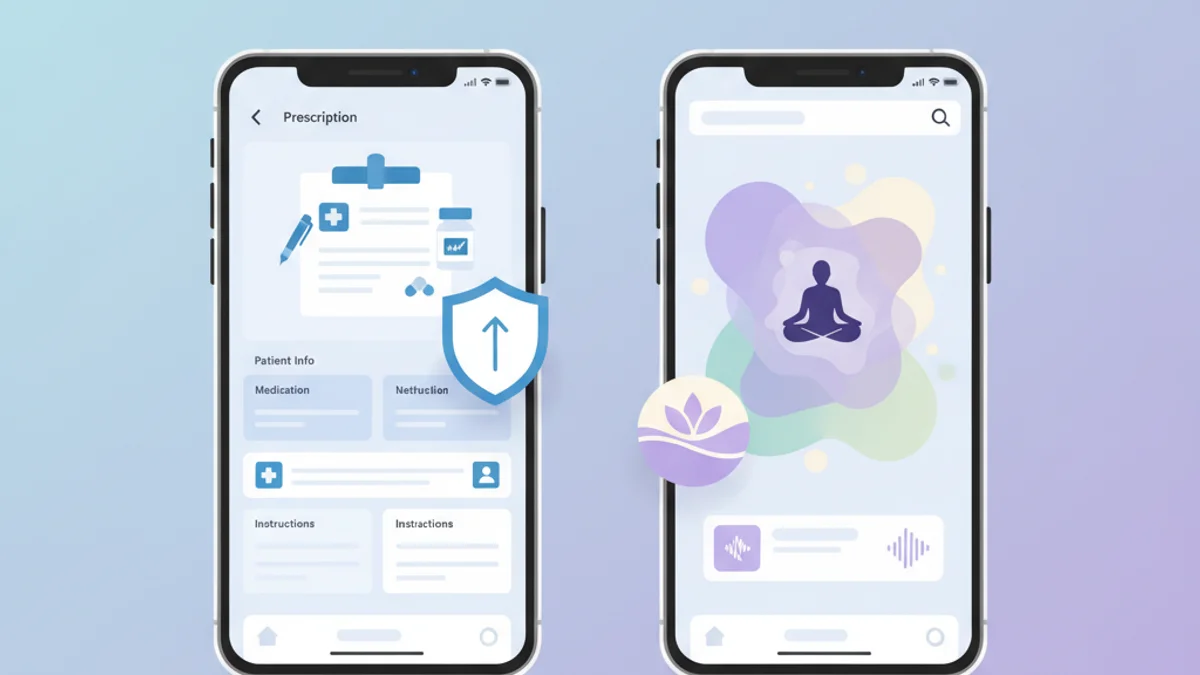
By definition a prescription digital therapeutic (PDT) is software that a physician authorizes for a patient. It is software that the FDA clears for a defined medical state and that insurance providers frequently cover. In contrast a meditation app is software that any person can obtain for managing tension, sleep or general health. Although both types of software exist on mobile devices, the regulations, the proof of efficacy and the prices are distinct. The “mental health app” group currently exists in three levels, which results in different levels of availability and different expectations for the user.
The three categories of mental health apps
Wellness apps consist of products like Headspace, Calm and Insight Timer. These are consumer products that address general tension, sleep habits and mindfulness. Because they do not make claims about medical treatment, they do not require authorization from regulators. For those products, the price is usually between $60 and $100 for one year.
Clinically-informed apps occupy the middle position. These apps employ methods that come from peer-reviewed studies and clinical work but they do not have a classification as medical devices. As an example, 6th Mind belongs to this group. It uses audio-visual entrainment (AVE) sessions that come from over 800 sessions at 6th’s practice office in Sofia, focused on depression, anxiety, insomnia and burnout. Those apps are available for no cost or low cost and they serve as an addition to care from a professional.
Prescription digital therapeutics (PDTs) are medical devices that are subject to regulation. Examples are EndeavorRx for pediatric ADHD, Freespira for panic disorder or PTSD, and Somryst for chronic insomnia. To get these a clinician must provide a prescription after they make a diagnosis. If a person wants to use them, insurance may pay the cost or the patient may pay more than $1,000 for a treatment period.
What FDA clearance actually means
The FDA clears PDTs through the 510(k) process or De Novo classification. To get this clearance, the maker must show that the software is safe and that it functions as intended for a specific condition. This evidence usually comes from randomized controlled trials. EndeavorRx, for example, draws on a trial that includes 348 children to support its authorization. Somryst’s data come from more than 1,400 participants.
But this clearance does not ensure that the app is more effective than options that do not require a prescription. It indicates that the regulator agreed with the evidence for a specific use. It is a choice by a regulator and is not a statement that a product is better than every other choice.
The pricing reality across the three tiers
| Category | Typical cost | Who pays | How you get it |
|---|---|---|---|
| Wellness apps | $60–$100/year | Consumer | App store |
| Clinically-informed apps | Free to $50/year | Consumer (or free) | App store |
| Prescription digital therapeutics | $500–$1,500 per course | Insurance or out-of-pocket | Doctor’s prescription |
In this case the difference in price is not a measurement of quality. In a 2024 review of 28 meta-analyses with 118,970 participants, researchers find that digital CBT for insomnia produces results that are similar to therapy from a person, regardless of whether the software has a prescription label or not. The quality of evidence is more important than the category of regulation.
Evidence: RCTs, user surveys and everything in between
The type of evidence is the detail that a person should examine.
- Prescription digital therapeutics typically publish RCTs in academic journals. Somryst has multiple RCTs for chronic insomnia, and EndeavorRx has data from trials for pediatric ADHD.
- Clinically-informed apps point to research on the methods they use, like CBT, mindfulness or AVE. They may also have data from their own users. 6th Mind uses AVE methods that have support from decades of research and 800+ sessions in a practice office, though the app itself is not part of an FDA trial.
- Wellness apps may use surveys of users that the company pays for, or small pilot studies. These are weaker evidence than RCTs.
If a person evaluates an app, they should ask if a published RCT exists for that specific app and that specific condition. If it does not, they should ask what the method is and if independent research supports that method.
Precision psychiatry is narrowing the gap
In a 2026 article on personalized mental health care, the APA Monitor describes a change that affects all three groups: this change includes pharmacogenomics, data from wearable devices and AI that links treatments to patients. PDTs are adding math that adapts to the user. At the same time, clinically-informed apps are using clinical data to improve their methods, and wellness apps are adding suggestions from AI. On the topic of personalization, the difference is getting smaller, but the difference in evidence and regulation remains large.
A decision framework for choosing
- Diagnosed condition that matches a PDT indication: speak with your clinician. Access depends on the rules of your insurance and specific diagnostic criteria.
- Symptoms you want to handle without a prescription: a clinically-informed app is often a suitable starting point. 6th Mind is free, is based on data from clinical practice and focuses on depression, anxiety, insomnia and burnout.
- General tension, sleep or mindfulness: a wellness app is a functional choice. The differences between Headspace, Calm and Insight Timer are mainly about the amount of content and the cost.
- High symptom levels, crisis or a complex history: an app is not a sufficient primary treatment on its own. Start with care from a professional and view digital tools as things that add to that care.
Frequently asked questions
Is a prescription digital therapeutic more effective than a meditation app? As it relates to the specific condition for which it has clearance, a PDT usually has evidence that is more robust. For general tension or sleep habits, a wellness or clinically-informed app that has a good design can produce results that are equal to or better than a PDT, because the PDT is not for that purpose.
Do I need insurance for a prescription digital therapeutic? It is often the case that you do. With many PDTs, manufacturers bill through insurance, but some provide options where you pay with cash. Coverage is different depending on your plan, your diagnosis and your country.
Is 6th Mind a prescription digital therapeutic? No. It is a clinically-informed app that is free to use, is available for anyone to download and comes from clinical practice. It is a tool that supports other methods and is not a medical device that the government regulates.
How do I know if the evidence for an app is trustworthy? To find this out you should search for randomized controlled trials that other scientists have reviewed, instead of surveys from users. On those studies check if the researchers tested the actual app and not just the general method. By asking if the trial was independent or paid for by the company, you can evaluate the data.
Sources
- “Trends in personalized mental health care” - APA Monitor, January/February 2026
- “The biggest mental health treatment trends in 2026” - Skyway Behavioral Health, 2026