Announcing 6th Mind version 2
6th Mind version 2 is here, and it is still free. Meet headset mode, which turns your phone's screen into a full-field entrainment light source, plus open-eyes sessions, Mental 6-packs, and the new web Session Library.
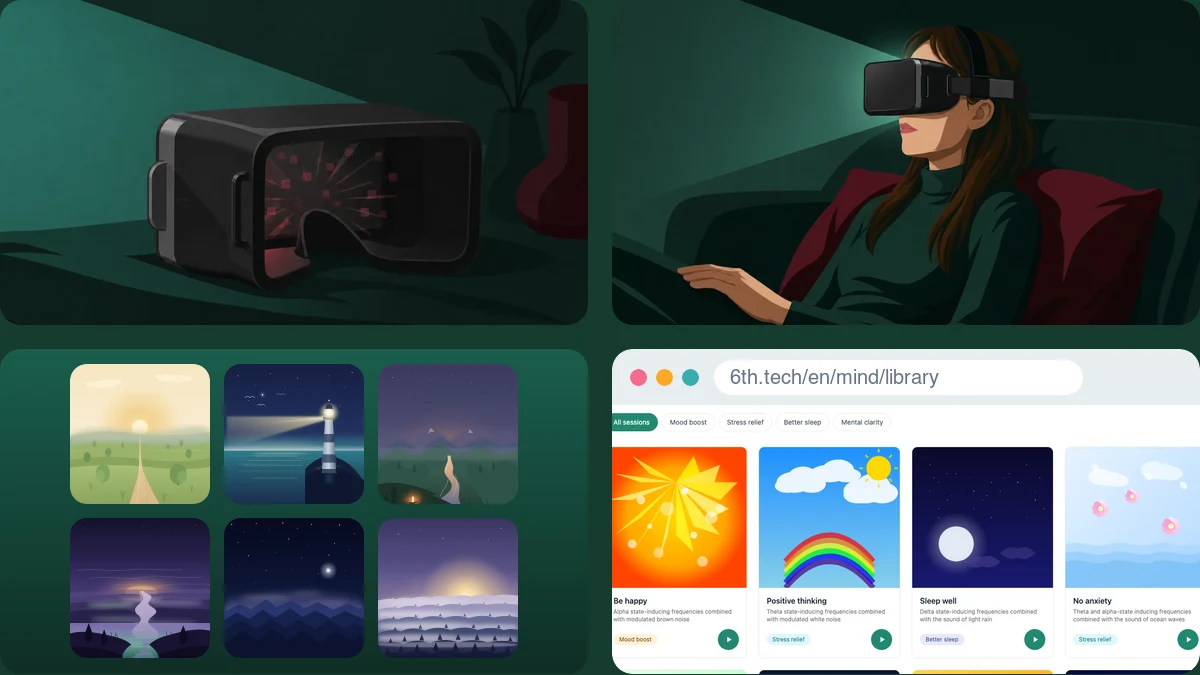
In a recent post about who we are, we asked whether a mobile phone can deliver an optimal audio-visual entrainment (AVE) experience. Were the speaker and camera flash already working at their full potential, or did a significant gap remain between phones and professional hardware?
With the release of version 2, we found that this gap is large.
We’re shipping the most extensive update in the app’s history: a headset mode for audio-visual entrainment, sessions you can do with your eyes open along with a new family of animations, themed session bundles, a daily routine you can expand, and a website library you can browse on a bigger screen.
It’s worth stating up front: 6th Mind is still free. Every session, and the new headset mode, is available with no cost and no ads.
The most powerful AVE device might already be in your pocket
As of today, a mobile phone is potentially the most effective audio-visual entrainment device available to most people. We ran tests for many months to be comfortable saying that. It might seem unlikely, because professional AVE systems are built for one specific purpose. And in the past we said that professional equipment has intensity and timing precision “beyond what a phone flash can reproduce”.
But notice the word flash. The camera flash was the limit. So in version 2 we stopped treating it as the only light source and built a new way to deliver the light.
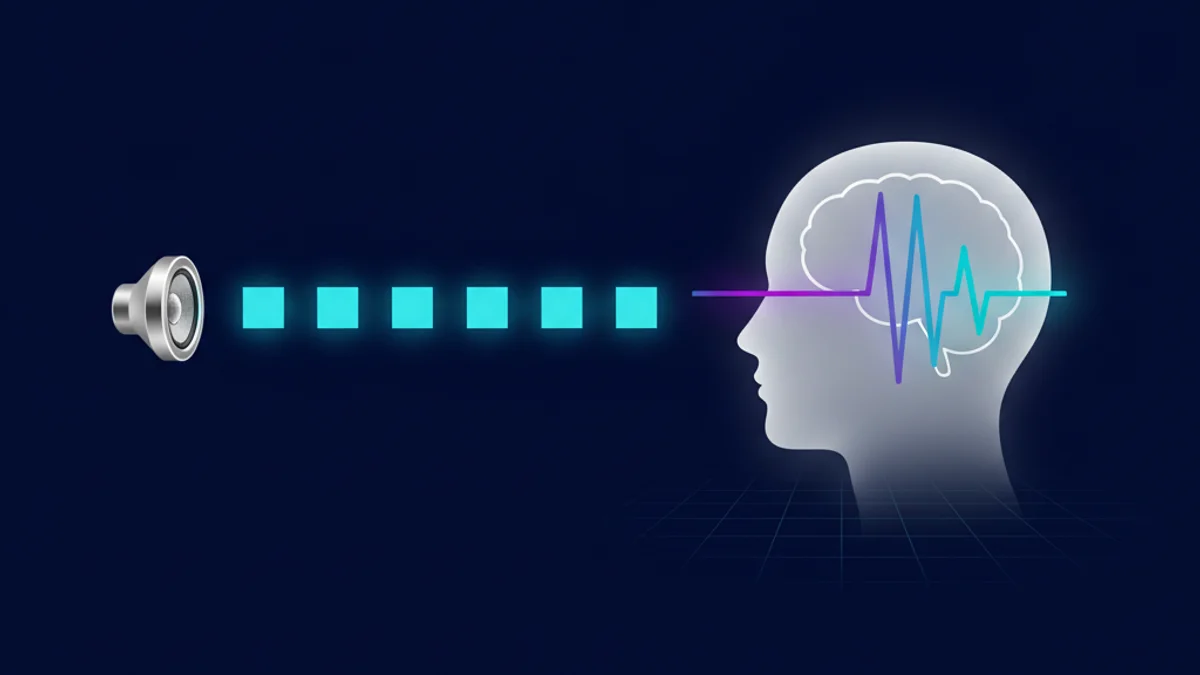
Headset mode runs the session through the phone’s screen instead of the flash. You place the phone into a simple 3D-printable headset that holds the screen close to your closed eyes and blocks out surrounding light. The screen splits into two halves, one per eye, so each eye sees patterns pulsing at the session’s frequency.
Modern smartphone displays are very advanced, which makes them excellent for this: the screens are bright, and they refresh more than a hundred times a second. Headset mode puts those features to work in several ways:
- Full-field stimulation. The rhythm fills your entire visual field, each eye driven by its own half of the screen. Deeper entrainment, less distraction.
- Colour tuned to the brain state. Because the screen is so bright, we can give each frequency band its own colour, chosen for visibility through closed eyelids, from lavender in delta to green in alpha.
- Crisp flicker at every frequency. If a screen pulses as one big block, it blurs into a steady glow at higher frequencies. By dividing each eye’s field into cells and lighting only a subset per beat, the pulse stays sharp from 1 Hz up to the physical limit of the display.
- Gentle on the eyes. On a phone screen the light is diffuse and even, and because the brightness is adjustable, it never gets as harsh as a bare strobe.
- Light and sound in lock-step. The screen patterns and the isochronic tones run off the same frequency data, so they stay synchronized frame by frame.
- It gets better when your phone does. Buy a phone with a brighter screen or a higher refresh rate, and the quality of the entrainment improves automatically.
The headset follows the same philosophy as the software: it’s kept as affordable as possible. It’s a 3D-printable design in two parts, a universal main body and a holder specific to your phone model. You can print it at home for a few dollars of filament, or pay a service to make it for around $30. The app walks you through every step, including how to get a simple head strap.
That also makes it, almost certainly, the most affordable AVE “device” you can buy. Dedicated audio-visual entrainment hardware usually runs into the hundreds of dollars. Here the expensive parts, the light source, the audio, the timing electronics, are already inside the phone you own. The only thing you actually buy is a piece of plastic that holds it in the right place.
We tested headset mode for many months, across different phones, frequencies, and visual patterns, before releasing it. It comes closer than anything we’ve built to reproducing a professional session at home.
Open your eyes
Headset mode also makes something possible that the camera flash never could: doing sessions with your eyes open.
Most AVE devices can’t. They use high-intensity LED strobes designed to drive light through closed eyelids, and looking straight into one of those with your eyes open is, at best, deeply unpleasant. A phone screen, by contrast, is a soft, diffuse light source, and because the software controls the brightness, we can turn the flicker down to a level that’s comfortable to watch.
And the science says eyes-open flicker works. For decades, researchers have studied the brain’s response to rhythmic light, the steady-state visual evoked potential, and it’s measured while people watch a flickering screen with their eyes open. Controlled EEG studies show that regular screen flicker entrains the brain’s alpha rhythm in exactly this setup (Notbohm et al., 2016), and the recent wave of 40 Hz gamma research, including at-home trials, is built entirely on eyes-open light stimulation and reports it to be safe and well tolerated (He et al., 2021). Eyes open or closed, the entrainment is real.
Open eyes mode lets you keep your eyes open and watch the patterns directly. When the session starts, the screen brightness drops to a comfortable level so the flicker is easy on the eyes.
Alongside it, we built open-eyes animations, short moving visuals that appear just before a session starts. They include slowly turning spirals and rings that rotate in opposite directions, the kinds of patterns researchers have long used to capture attention. Their job is to settle your gaze and quiet distractions before the entrainment begins. Each time, the app picks a different one.
Both are optional. If you prefer the classic closed-eyes experience, nothing changes.
Mental 6-packs
Until now, the app offered its default sessions plus a 15-session program. Version 2 adds a new feature: Mental 6-packs.
A Mental 6-pack is a set of exactly six sessions built around a shared theme, like a set for winding down in the evening or one for sharpening focus. The name is a nod to the six sessions our team put together for your mental fitness. Install a pack and its sessions appear in their own section on your home screen, ready to play offline like everything else in the app.
You can browse the packs in the app at no cost. To install them you create a free account, so your packs are available across all your devices.
Enhance your routine
The 15-day personalized program works the way it always has: one session each day, chosen for you by the assessment you take at the start. Plenty of people want more than that, and version 2 gives them the option without disturbing the program itself.
Enhancing your routine means adding extra sessions to the schedule you already have. You pick one or both of two purposes. Mental clarity is for the morning, or before a stretch of work that needs concentration. Better sleep is for the half hour before you go to bed. Then you choose how full the day should be, one session to three, and set your own reminder time for each purpose.
The mental clarity sessions are built around 40 Hz. Each one climbs through beta into gamma, then holds at exactly 40 Hz for most of its length. Researchers at MIT have spent a decade on that specific frequency, and it’s the one tied most consistently to the focus and memory benefits of 40 Hz gamma stimulation. The better sleep sessions work in the opposite direction, easing you down through Theta into Delta.
At one session a day, the enhanced sessions alternate with your program. At two, you get your program session plus an enhanced one. Three requires both purposes, and the day then holds a mental clarity session in the morning, your program session, and a sleep session in the evening, each arriving at its own reminder time.
The extra sessions are drawn from everything that carries the purpose you picked, including the sessions in any Mental 6-packs you have installed, and nothing repeats until the app has been through every other option. Install a pack and the daily routine gets more varied.
If you’d rather not enhance anything, nothing changes. One session a day, exactly as before.
The Session Library: 6th Mind on the big screen
The last piece of version 2 doesn’t live in the app at all. On our website, the new Session Library is a full catalogue of everything 6th Mind offers: every default session, with its purpose and frequency profile, and every available Mental 6-pack.
On a laptop it’s easy to browse the sessions and read what each one does. Comparing packs side by side, you can find options the app doesn’t feature on its home screen. When you find a pack you want, you install it right from the browser with your 6th Mind account, approve it with a single tap on your phone, and it appears in the app automatically.
Still free, still the same mission
Version 2 is the biggest step 6th Mind has taken, but the deal is the same: the app is free, has no ads, and needs no extra hardware — with no subscription needed to use it. If you want the deepest experience, the only cost is a 3D-printed headset. That’s it.
Everything here comes from the same place as the first version: over 800 sessions measured in our Sofia office, EEG data recorded before and after every one of them, and a stubborn belief that evidence-based brain stimulation shouldn’t be locked behind expensive equipment.
So, back to the question we left open: had we reached the limit of what a phone can do?
Not even close.
Get 6th Mind free, browse the new Session Library, and if you’re new to the science, start with our explainer on audio-visual entrainment.
Sources
- “Flicker regularity is crucial for entrainment of alpha oscillations” - Notbohm, Kurths & Herrmann, Frontiers in Human Neuroscience, 2016
- “A feasibility trial of gamma sensory flicker for patients with prodromal Alzheimer’s disease” - He et al., Alzheimer’s & Dementia (TRCI), 2021
- “The steady-state visual evoked potential in vision research: A review” - Norcia et al., Journal of Vision, 2015