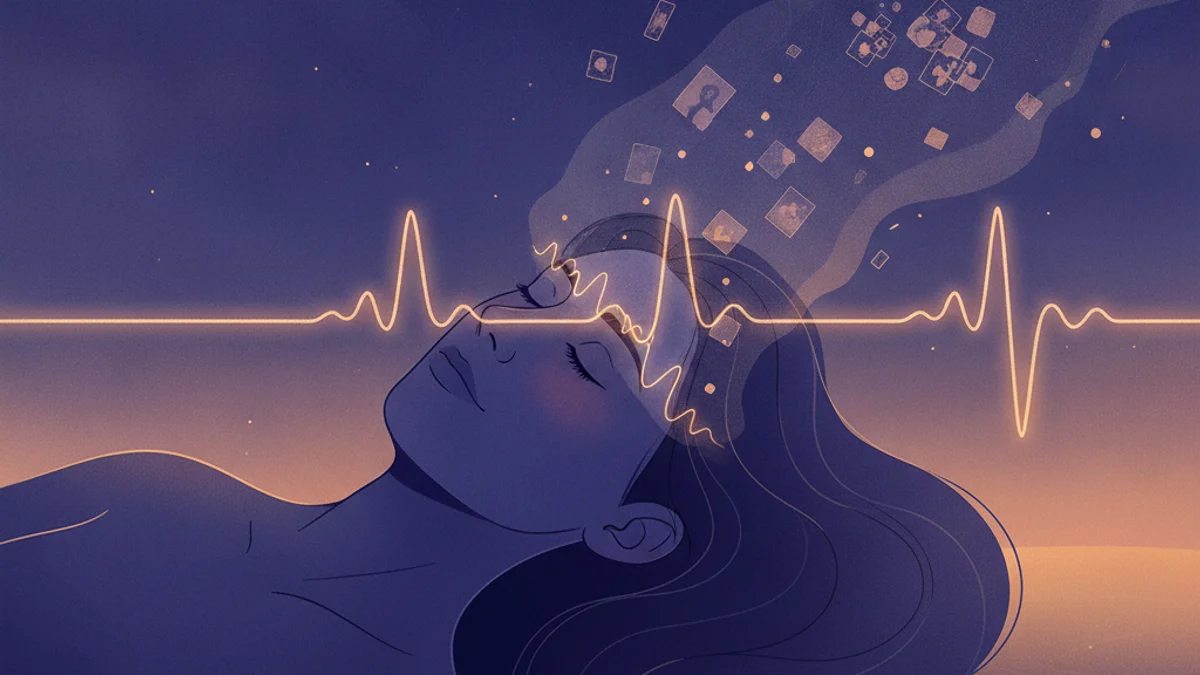
Delta waves and deep rest: what the slowest brain rhythm does while you sleep
Delta waves are the 0.5-4 Hz rhythm of deep sleep. What the evidence says they do for memory, recovery and brain clearance, whether you can increase them on purpose, and what delta audio can realistically offer.
The brain produces delta waves as its slowest rhythm at a frequency of 0.5 - 4 Hz. The waves are the primary feature of N3 sleep. The N3 stage is the deep phase that occupies the majority of the first half of the nocturnal period. The 2026 evidence indicates that deep sleep performs measurable functions for memory and physical recovery. The data also suggests that the most effective method to increase this stage is acoustic stimulation synchronized to the slow waves of the individual - this method is different from a 2 Hz audio track that plays in the background.
What are delta brain waves?
Delta waves are at the lowest position on the EEG spectrum - they are below the theta band which is 3-8 Hz. Sleep researchers distinguish between two specific phenomena:
- Delta activity, which is approximately 1-4 Hz - this activity appears as waves with high amplitude and low frequency across the scalp.
- Slow oscillations, which are below 1 Hz - those represent the transition between cortical up states and down states - this rhythm is the mechanism for most functional processes.
In a healthy adult, N3 is approximately 13 - 23 percent of the nocturnal period. The stage is most frequent in the first two or three sleep cycles. Delta waves are also present outside of sleep, like in specific pathological conditions - this presence makes the frequency band a marker of a state rather than a direct benefit.
What is deep sleep actually doing?
Two functions have strong evidentiary support - the first function is memory consolidation. During slow wave sleep, slow oscillations connect with sleep spindles in a precise temporal relationship. The strength of this connection is proportional to how much information an adult remembers the following day. The brain stabilizes experiences that it marked with theta activity during the learning process. The encoding during the day and consolidation at night are a single sequence.
The second function is physical and autonomic recovery - the release of growth hormone is at its highest level during early deep sleep periods. The heart rate and blood pressure are at their lowest levels of the 24-hour cycle. It is the stage that the body restores with the highest priority. After a loss of sleep, N3 returns to normal levels before REM sleep does.
Does deep sleep clear waste from the brain?
The process occurs partially but the evidence from humans is less extensive than news reports suggest. The glymphatic system removes metabolic byproducts like amyloid beta and tau mostly during slow wave sleep. A June 2026 review in Neuroscience & Biobehavioral Reviews describes a translational gap. There is a difference between animal studies where the mechanism is clear and human studies where data is scarce. “Sleep washes your brain” is a logical hypothesis that authors frequently present as a proven fact.
Can you increase deep sleep on purpose?
The method with the highest level of support is closed loop acoustic stimulation - this involves a quiet pulse of pink noise that a device delivers during the rising phase of a slow wave in the EEG of the user. A 2022 randomized crossover trial in Communications Medicine tests this technology at home with adults between 62 and 78 years of age. The trial enrolls 33 participants and carries 16 through to the final analysis. It reports a consistent increase in slow wave activity for the group, small effects on daily function, and large differences between individuals. A February 2026 review in Frontiers in Neuroscience states that EEG markers change reliably but cognitive benefits are not consistent.
| Approach | What it changes | What the evidence supports |
|---|---|---|
| Closed loop acoustic stimulation | Slow wave activity synchronized to the user | Consistent EEG changes - small and inconsistent effects the next day |
| Open loop delta audio | Subjective relaxation and the start of sleep | Small studies - useful for relaxation but does not increase slow waves |
| Sleep regularity and timing | Total N3 during the night | The most effective and practical method |
Do delta binaural beats work?
A July 2026 study in Acta Psychologica examines this specific product type. The researchers test 20 healthy students over three nights using delta range binaural beats on a 174 Hz carrier, and they measure the start and maintenance of sleep with EEG. The study offers data instead of marketing claims. The sample is 20 students.
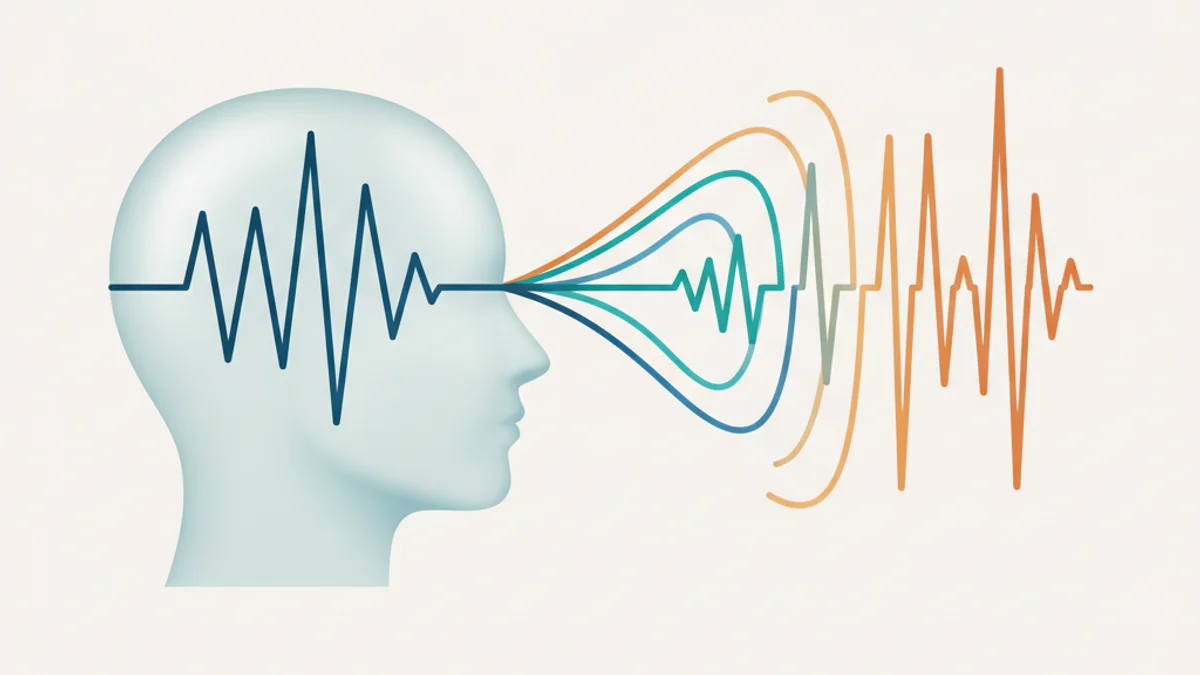
The internal structure of a system is more significant than the number of participants in a study. Open loop audio emits sound at a constant frequency regardless of whether the brain produces a slow wave. By contrast closed loop systems initiate sound only when the brain produces a wave. The accurate function of delta entrainment is therefore the movement into a state of rest, rather than the increase of the slow wave sleep that occurs later. The 6th Mind app provides delta and theta audio sessions that last 6 or 11 minutes. It includes a light from the camera flash that pulses, though a user can deactivate this for a session that uses only sound. That same relaxed state before sleep is the one a lucid dreaming practice builds its methods on.
What actually protects your delta sleep
The timing of a daily schedule is more effective than any electronic hardware. And consistent times for going to bed and waking up ensure that the sleep cycles at the start of the night remain complete. Alcohol is misleading here, because it increases slow wave sleep during the first hours and then causes frequent waking during the second half of the night. In a cool room, around 18-19°C, the body reaches the drop in core temperature that it needs more easily. There is a reduction in slow wave sleep as a human grows older, which is a process that generally cannot be prevented.
One caveat belongs with all of this: more slow wave activity is not automatically better. In stimulation trials, researchers observe small decreases in REM sleep when slow wave activity increases, and sleep architecture is a system of finite resources where one stage often takes time from another. Our office in Sofia works with depression, anxiety and insomnia. There, brainwave sessions are one instrument within clinical work rather than a commercial product for sleep. Because of the difficulty of chronic sleep issues, cognitive behavioral therapy for insomnia is the primary medical recommendation.
Frequently asked questions
How much deep sleep do you need? A healthy adult requires approximately 13 - 23 percent of the total night and this sleep occurs mostly in the first half of the period. The percentage is lower in older adults.
Can a delta audio track give you more deep sleep? There is no reliable data to support this result. The experiments that successfully increase slow wave activity use closed loop stimulation that is synchronized with specific brain waves. It is more accurate to state that delta audio helps with the relaxation process before sleep.
Sources
- “AQP4-mediated glymphatic clearance: Sleep, neurodegeneration, and the translational gap” - Neuroscience & Biobehavioral Reviews, 2026
- “The effect of delta binaural beat on sleep onset and maintenance based on EEG signal analysis” - Acta Psychologica, 2026
- “Auditory deep sleep stimulation in older adults at home: a randomized crossover trial” - Communications Medicine, 2022
- “Acoustic stimulation and other emerging approaches to enhance sleep: design notes for the next generation of closed-loop neurostimulation technology” - Frontiers in Neuroscience, 2026